
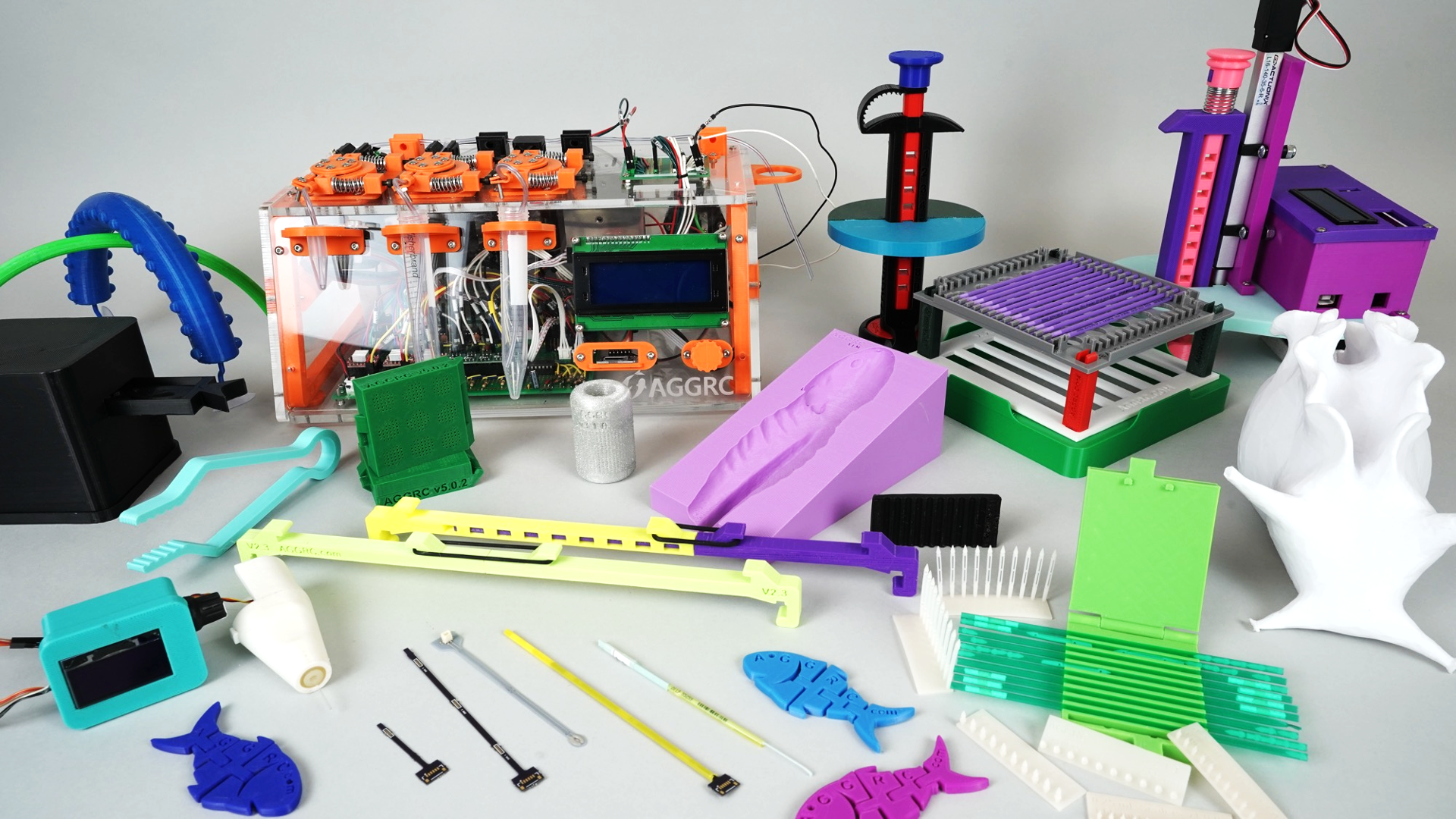
Community-Driven Technology Solutions for Safeguarding the Genetic Resources of Aquatic Species
Featured Projects
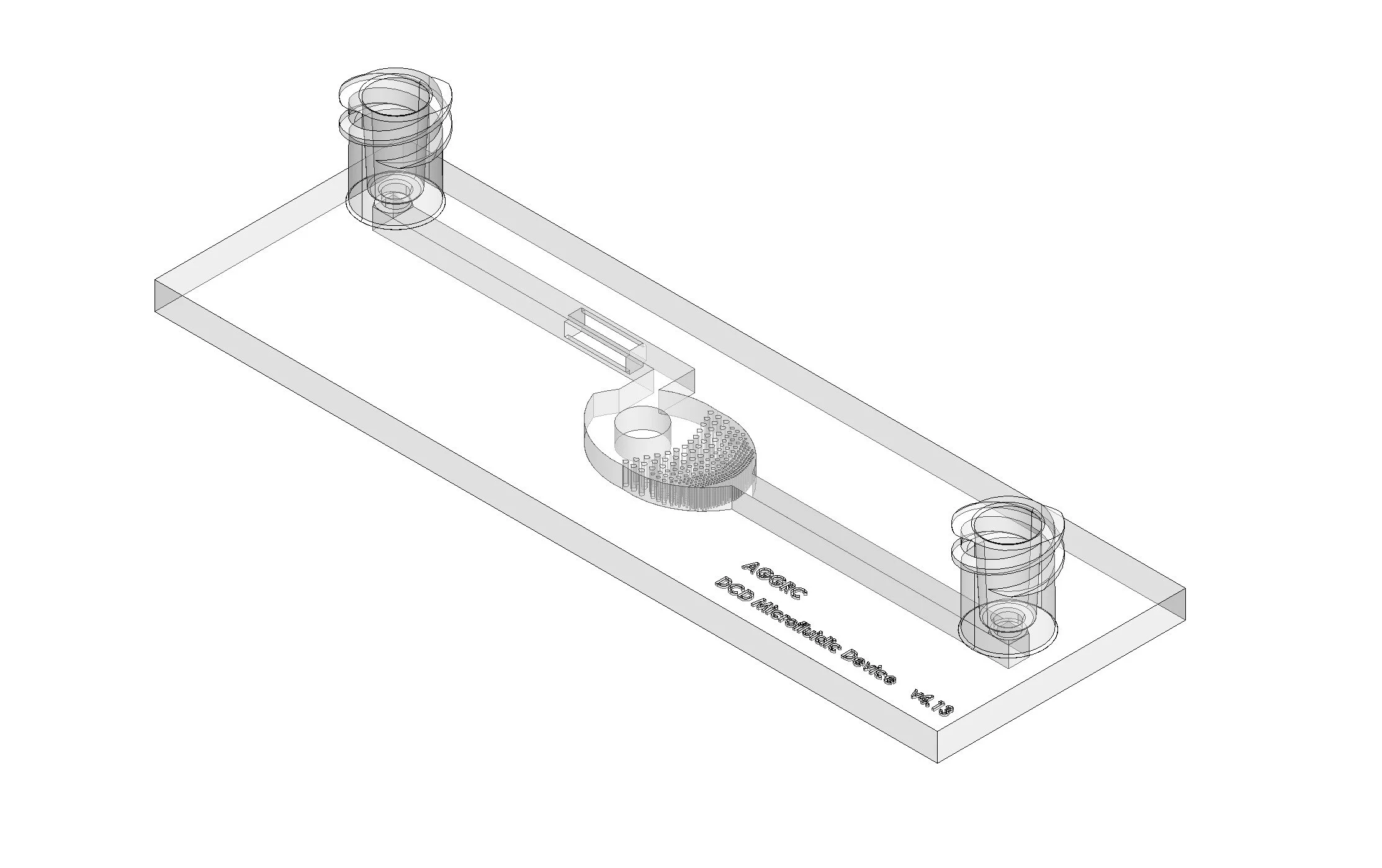
The Dechorionation–Cell Dissociation (DCD) Microfluidic Device is a microfluidic platform for integrated zebrafish embryo processing. The device combines mechanical dechorionation, passive chorion filtration, and downstream dissociation of released embryonic contents within a single architecture. Key regions include an inlet channel, an upstream dechorionation zone with constricted corner subchannels, a downstream filtration chamber with graded tear-drop–shaped micropost arrays, and an outlet channel for fragment collection.
This device was developed as an enzyme-free, geometry-driven alternative to conventional manual and enzymatic embryo processing. It is intended to support standardized, reproducible, and scalable workflows, and can also serve as a modular unit for future automated systems.
This device was developed at the Aquatic Germplasm Center of Research Excellence (AGCoRE) and Aquatic Germplasm and Genetic Resources Center (AGGRC) of the Louisiana State University Agricultural Center, in collaboration with the Department of Electrical & Computer Engineering at Louisiana State University, the Department of Biological & Agricultural Engineering at LSU and LSU Agricultural Center, and collaborators at Michigan State University.
The design was developed by Mohsen Norouzi as part of doctoral research at Louisiana State University and a broader multi-year effort to develop standardized and reproducible open-hardware tools for biological processing, germplasm preservation, and related biomedical research application.
This study was funded in part by the National Institutes of Health Office of Research Infrastructure Programs (R24-OD028443, R24-OD034058, and R24-OD037797), the National Science Foundation (Award 2229680), and the LSU AgCenter Agriculture Collaborative Research Program. Further assistance was provided by the U.S. Department of Agriculture, National Institute of Food and Agriculture, through Hatch project LAB94420 and award 2024-70007-43549.
Please visit AGGRC.com to learn more about our work. Feedback on our device can be provided by emailing us at aggrc@agcenter.lsu.edu or by filling out or feedback form: https://forms.cloud.microsoft/r/sgBh4A8tXe
Complete design files, including STL, 3MF, and SolidWorks files, are also available on GitHub at: https://github.com/aggrc/Dechorionation-Cell-Dissociation-DCD-Microfluidic-Device
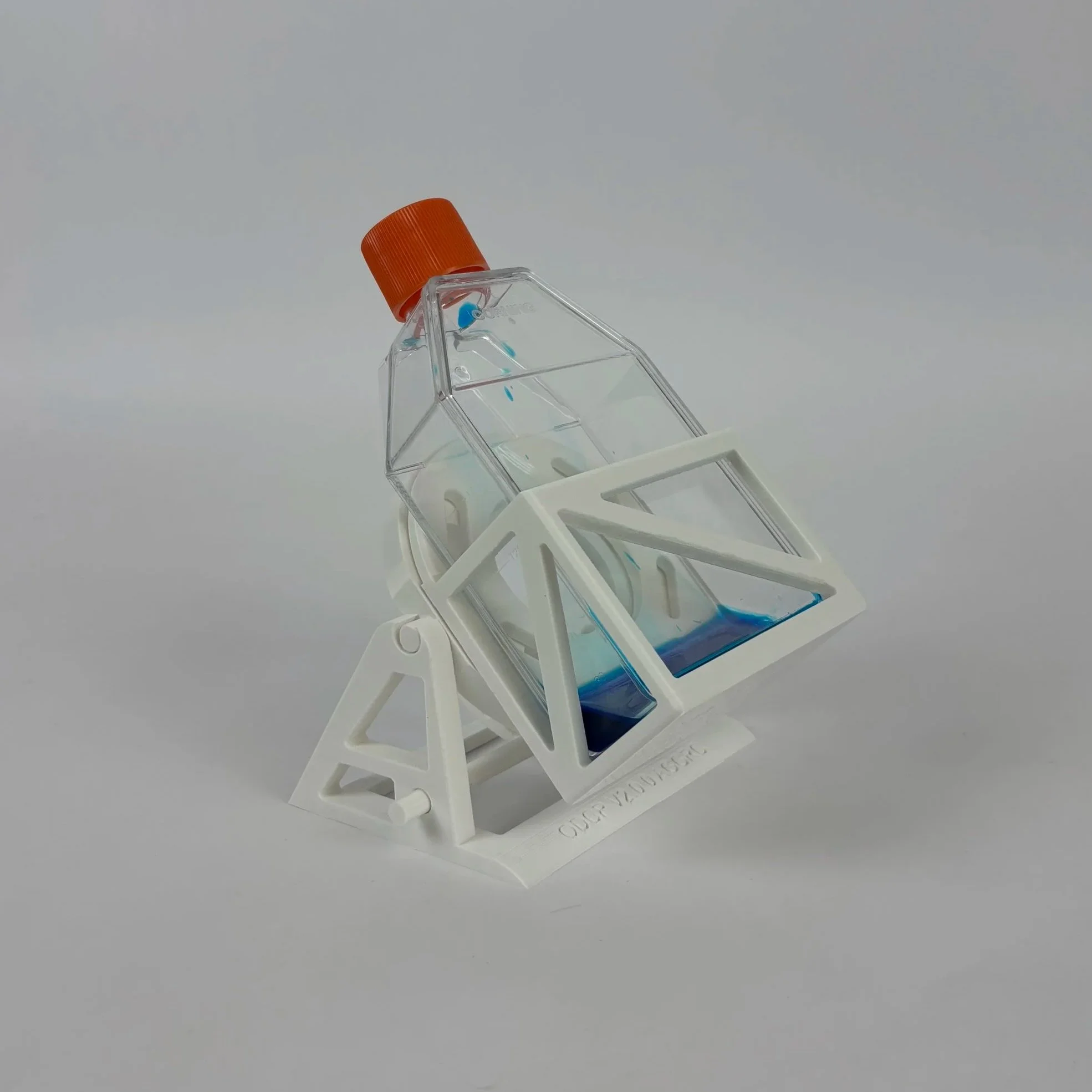
The purpose of the Omni-Directional Cell Plate (ODCP) is to facilitate early, middle, and late-stage growth of cells by tilting a cell culture flask. Based upon how the flask is tilted it changes the surface area distribution of the cell culture media. The design includes rotation points on the x-axis and y-axis to allow for a range of custom settings that fit user needs. In early-stage development the media is isolated to a single corner of the flask allowing for optimal growth. As the cells grow the user can decrease the angle of the tilt for later development, and when the flask begins reaching capacity the ODCP can be stored in a standard flat position.
Developed by the Aquatic Germplasm Center of Research Excellence (AGCoRE) and Aquatic Germplasm and Genetic Resources Center (AGGRC) at the Louisiana State University Agricultural Center. Designed by Stephen Rice under the guidance of Jack Koch. Honore Miguel Simo Tengwo made original contributions. This work was funded in part by the National Science Foundation (Award: 2319783) in partnership with the University of Alabama Birmingham and the National Institutes of Health Office of Research Infrastructure Programs (Awards: R24-OD028443, R24-OD037797, R24-OD034058).
Please visit AGGRC.com to learn more about our work. Feedback on our device can be provided by emailing us at aggrc@agcenter.lsu.edu or by filling out or feedback form: https://forms.cloud.microsoft/r/sgBh4A8tXe
Detailed Description: The ODCP V2.0.0 design consists of four interlocking parts, and those are: the basket, the rotator, the base, and the pin. The basket holds the cell culture flask with two open sides to allow for easy insertion and cell culture visibility. The back of the basket has two protruding pins that go into holes that are on the rotator. The holes on the rotator are separated in a circular pattern that allows the user to take the pins and insert them at one of the pre-selected angles, providing the first axis of rotation. The rotator has an axle running through the center of it, and this snaps into the holes located on top of the base, providing the second axis of rotation. There is a half-circle with holes on the underside of the rotator that locks the system into place when the pin is slotted into the hole on the bottom of the base and the hole on this half-circle. When all components are combined they provide a stable, interlocking, and customizable structure to facilitate cell growth.
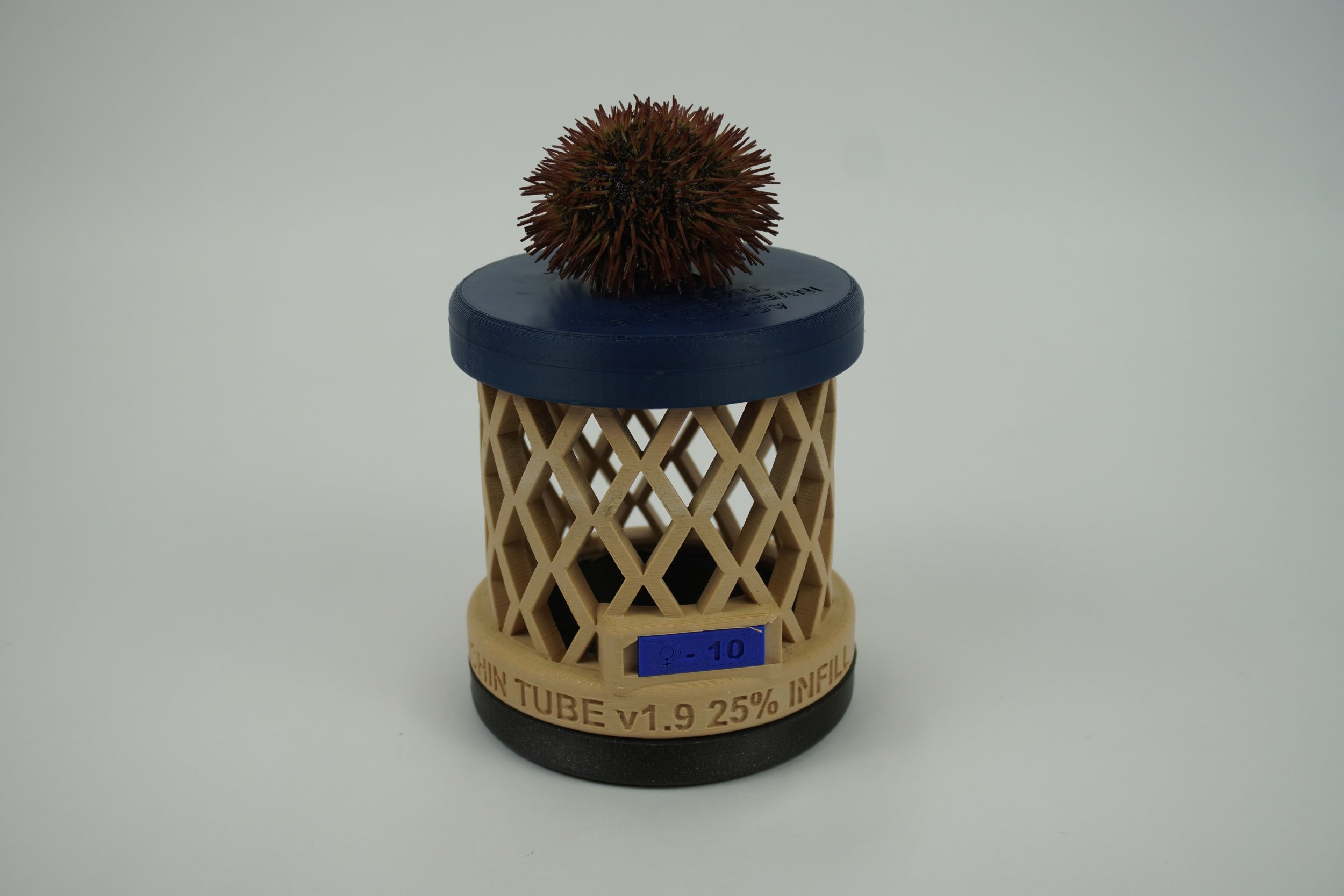
There is little standardization among invertebrate shipping containers and labeling of containers simply relies on permanent marker. This invertebrate tube is fully reusable with a material cost of <$2, is crush-resistant, and has an integrated labeling system. The invertebrate tube also functions as a container to segregate individuals during husbandry and experiments. The tube is modular allowing multiple tubes to be connected to adjust the space available for the occupant. The bottom of the tube can be printed with different degrees of air space (i.e., infill setting) so tubes can be engineered to float upright (heavier bottom) or on the side (lighter bottom). The top of the tube has an integrated feeding hole. This device will increase efficiency of husbandry and offers a scalable and standardized solution for shipping and experimentation. This device is also generalizable to other species beyond sea urchins.
Note: This hardware has a 90˚ overhang but do not print with any supports. Updated version is under development.
Developed by Cameron Bonds, Mary Jo Dardis, Honore Miguel Simo, Jack Koch at the Aquatic Germplasm and Genetic Resources Center (AGGRC). This work funded by the National Science Foundation (NSF), National Institute of Health (NIH), USDA National Institute of Food and Agriculture (NIFA), LSU AgCenter, and USDA Hatch.
Please visit AGGRC.com to learn more about our work. Feedback on our device can be provided by emailing us at aggrc@agcenter.lsu.edu or by filling out or feedback form: https://forms.cloud.microsoft/r/sgBh4A8tXe
All Fusion 360 files can be found on our GitHub through the following link: https://github.com/aggrc/Invertebrate-Tube-V1.9.0
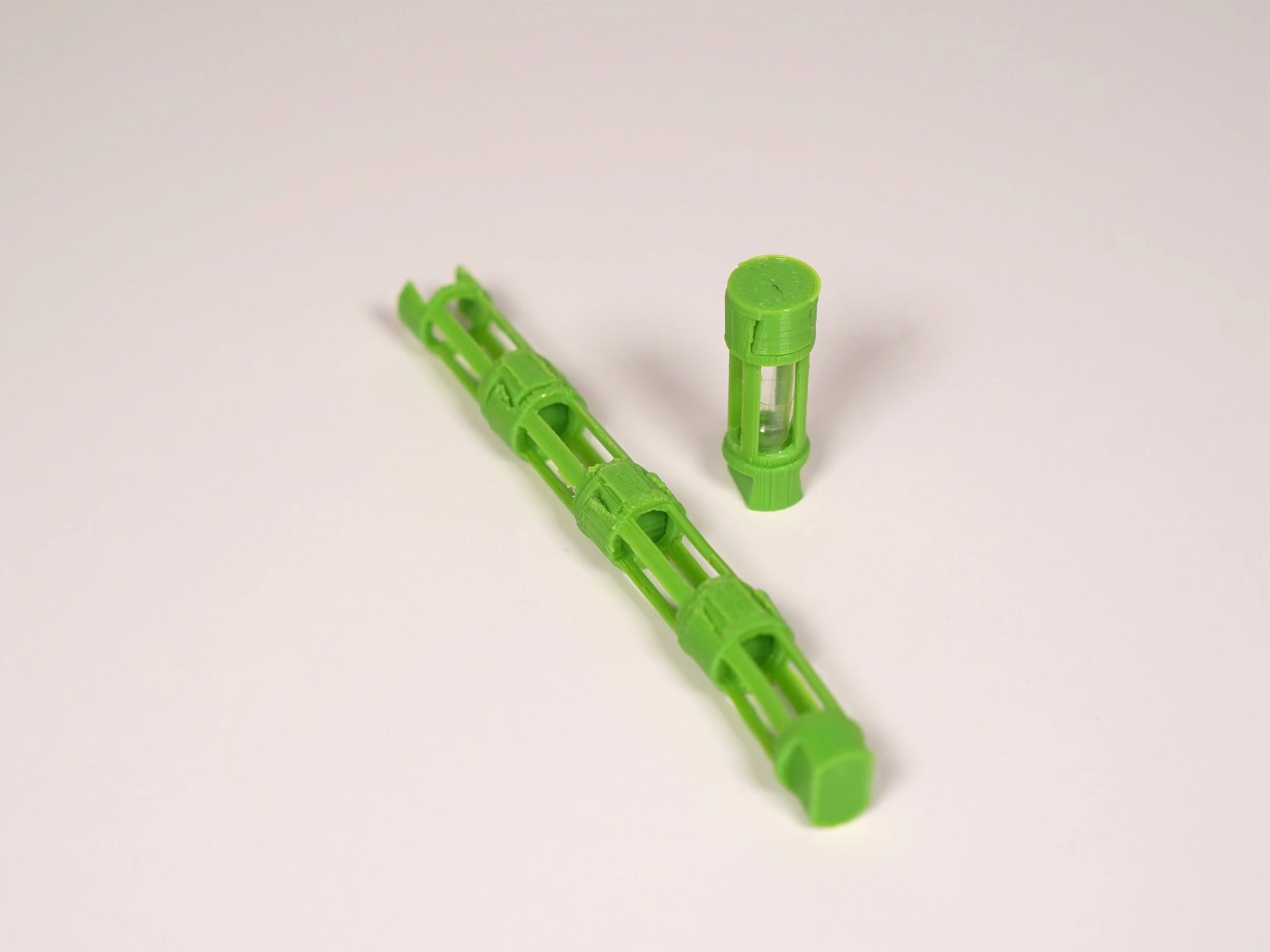
This open hardware package was designed to facilitate cryopreservation using pharmaceutical hard capsules, which can be made of gelatin or plant-based materials, as containers. These capsules have been used in the cryopreservation of aquatic species' gametes as an alternative to more traditional containers like straws and cryovials, offering a more accessible, low-cost, and biodegradable solution.
The package includes a versatile rack with two interlocking pieces: when used together, the rack is configured for size 3 capsules, and when the top piece is removed, it adapts to accommodate size 0 capsules. This allows users to fill the capsules with the material to be cryopreserved. Additionally, a modular device specifically designed for size 3 capsules, enabling their secure placement during the cryopreservation process and subsequent storage in liquid nitrogen tanks. To use the system, simply fill the capsule with the sample, insert it into the device, and attach the device piece to "seal" it. The tip device is then covered with a small cap, ensuring a secure cryopreservation setup.
This package was developed at the Aquatic Germplasm and Genetic Resources Center (AGGRC) at the Louisiana State University Agricultural Center. The package was originally designed by Thaiza Freitas. This work was developed during a doctoral exchange stay funded by the CAPES-PrInt program.
Please visit AGGRC.com to learn more about our work. Feedback on our device can be provided by emailing us at aggrc@agcenter.lsu.edu or by filling out or feedback form: https://forms.cloud.microsoft/r/sgBh4A8tXe
All Fusion 360 files can be found on our GitHub through the following link: https://github.com/aggrc/Modular-Capsule-Cryopreservation-Device
Accessible Technology for Aquatic Germplasm and Genetic Resources
Our interdisciplinary team is a resource hub to support Louisiana and global industry and community needs through technology development and expanded technology access for protecting the genetic resources of aquatic species.
Initiate a Project Inquiry
Provide project objectives and timelines for consideration by our team.